Sidelock vs Boxlock:
What’s the Difference?
Sidelock vs boxlock is one of the first comparisons encountered in the world of English double shotguns. The terms are useful, but they are often treated as grades of quality. In fact, they primarily identify two different ways of arranging the firing mechanism inside a break-action gun.
What does “lock” mean?
In this context, the lock is the mechanism that stores and releases the energy required to strike the cartridge primer. It includes components such as the tumbler or hammer, sear and mainspring. The familiar sidelock and boxlock names tell us where that mechanism is arranged.
They do not by themselves tell us whether a gun has ejectors, what grade of engraving it carries, how well it was stocked, whether its barrels remain in proof, or how carefully it has been maintained. Those are separate questions.
Lockwork on side plates
Much of the firing mechanism is mounted to lockplates inlet into the sides of the action and stock. The plates also provide a broad surface for engraving and allow the assembled locks to be removed for qualified inspection.
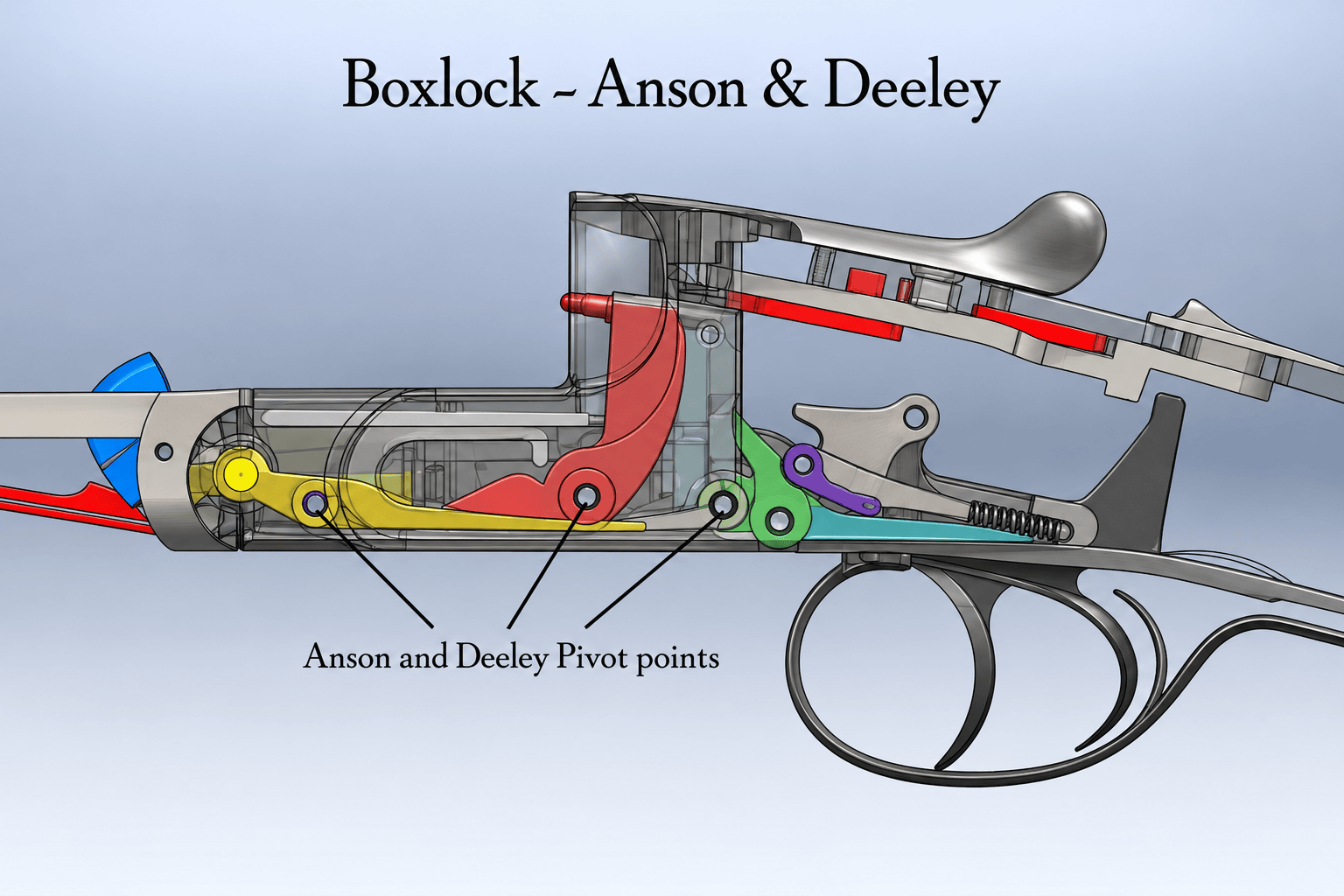
Lockwork inside the action
The principal mechanism is contained within the action body. The arrangement can be compact, strong and comparatively economical to manufacture, while still permitting extremely fine fitting, finishing and decoration.

Two enduring answers to the same problem.
British makers spent the nineteenth century refining breechloading guns, cocking systems, ejectors and safety mechanisms. The sidelock and boxlock emerged from that inventive period and have remained central to the sporting-gun tradition.
The boxlock milestone
William Anson and John Deeley patented the celebrated boxlock action associated with Westley Richards. Its internal hammers are cocked as the barrels fall open, creating a practical, self-contained mechanism that became enormously influential.
A landmark sidelock
Frederick Beesley patented a self-opening hammerless action used by James Purdey & Sons. It became one of the best-known expressions of the London sidelock tradition, though sidelocks exist in several mechanical forms.
Holland & Holland’s Royal side-by-side is another defining London sidelock, while firms such as Westley Richards demonstrated that a boxlock could be made to the highest standards. The historical record is therefore more nuanced than the idea that one layout automatically outranks the other.
How sidelocks and boxlocks compare.
| Point of comparison | Sidelock | Boxlock |
|---|---|---|
| Lockwork location | Mounted largely on lockplates at the sides of the action. | Contained largely within the action body. |
| External appearance | Usually identifiable by full lockplate outlines and pin placement. | Often has a cleaner action body, though decorative sideplates can imitate a sidelock silhouette. |
| Manufacture | Typically requires more parts, hand fitting and inlet work. | Usually more compact and economical to produce, depending on design and finish. |
| Engraving area | Broad lockplates offer a generous canvas for engraving. | Less side area unless fitted with decorative sideplates. |
| Inspection and service | Complete locks can often be removed as units by a qualified gunmaker. | Internal parts are accessed through the action and should likewise be handled by a qualified professional. |
| Handling and trigger feel | May permit elegant stocking and refined trigger work, but performance depends on the individual design and execution. | Can be lively, beautifully balanced and mechanically refined; layout alone does not determine feel. |
| Market perception | Often associated with best-quality London guns and higher cost. | Ranges from working guns to exceptional best-quality examples. |
The important distinction: action type is a design category. Quality is the result of materials, proportions, fitting, finishing, condition and the skill invested in the complete gun.
Sideplates do not always mean sidelock.
Some boxlocks wear decorative plates that extend across the sides of the action. These “sideplated boxlocks” can provide more engraving space and the visual sweep associated with a sidelock while retaining boxlock internals.

External clues can be helpful, but pin placement, plate shape and maker-specific features must be interpreted carefully. When the distinction matters for valuation, description or service, the mechanism should be confirmed by a knowledgeable gunmaker rather than assumed from photographs alone.
Ejectors are a separate question
Both sidelocks and boxlocks may be made as ejector or non-ejector guns. “Sidelock ejector” and “boxlock ejector” combine two descriptions: the lock layout and the method used to remove fired cases. One term does not imply the other.
Which is better: sidelock or boxlock?
There is no honest universal answer. A fine sidelock may represent extraordinary design and bench craftsmanship. A well-made boxlock may offer superb balance, durability and understated elegance. A tired or altered example of either type can be less desirable than a sound, original and well-documented gun of the other.
For a broader framework, see our complete guide to English double shotguns and our introduction to British proof marks.
How can you tell without taking the gun apart?
Begin with the visible form of the action. A true sidelock normally shows lockplate outlines and characteristic pins associated with the mechanisms mounted behind them. A conventional boxlock usually presents a more compact action wall without full lockplates. Yet decorative sideplates, unusual proprietary actions and later alterations can complicate the picture.
Maker names are useful starting points, not proof of mechanism. Firms produced multiple grades and action types, and trade-built guns were sometimes retailed under another name. Use clear photographs, serial and patent-use information, proof marks, period catalogues and a qualified examination together.

Do not remove lockplates or dismantle an unfamiliar gun merely to identify it. Old screws, wood and fitted components can be easily damaged. Leave disassembly and mechanical assessment to an experienced professional.
Continue with our profiles of Westley Richards, James Purdey & Sons and Holland & Holland, or read what defines an English sidelock.
Sidelock vs boxlock, in brief.
Is a sidelock always more valuable?
No. Sidelocks are often more expensive to make and are strongly associated with best-quality guns, but value depends on maker, grade, condition, originality, specification, provenance and demand.
Is a boxlock a lower-grade gun?
No. The boxlock was efficient to manufacture, which made it suitable for many price points. Exceptional boxlocks can exhibit first-rate barrels, stocking, engraving, balance and mechanical finish.
Can a boxlock have sideplates?
Yes. Decorative sideplates can give a boxlock more engraving area and a sidelock-like profile without carrying the firing mechanism on those plates.
Does a sidelock automatically have ejectors?
No. Lock type and ejection are separate features. Both sidelocks and boxlocks exist as ejector and non-ejector guns.
Primary and maker references.
Continue the story.
Explore more histories, technical guides and collection notes from English Doubles.