E.J.
Churchill
A distinctive London name shaped by fine sporting guns, practical shooting knowledge and one of the most recognizable short-barrel concepts in twentieth-century British gunmaking.
Tradition shaped
by practical experience.
Edwin John Churchill established his London gunmaking workshop in 1891, creating the foundation for a name that would become closely associated with the English sporting-gun tradition.
The firm later became especially identified with Robert Churchill, whose ideas about gun fit, fast handling and short barrels helped give the Churchill name an identity quite different from many of its London peers.

The beginnings of a London house.
Edwin John Churchill set up his London gunmaking workshop in 1891. His name soon became established within a competitive trade already populated by some of the most celebrated sporting-gun makers in Britain.
From the beginning, Churchill’s identity was tied to sporting use. The guns were not simply decorative objects; handling, fit and practical performance remained central to the firm’s reputation.

A strong point of view on the sporting gun.
Robert Churchill became the figure most closely associated with the firm’s twentieth-century identity. He was not only a gunmaker and gunfitter, but also a highly influential shooting instructor and writer.
His approach emphasized a gun that came naturally to the shoulder, moved quickly and worked with the shooter’s vision rather than against it. That philosophy became inseparable from the Churchill name.

A century of distinctive Churchill gunmaking.
Selected moments that help explain the development of the firm, its London identity and the ideas that made Churchill guns immediately recognizable.
A short-barrel concept with a long reputation.
The XXV became the model most closely linked to Churchill’s sporting philosophy. Built around 25-inch barrels, it offered a compact, lively feel designed for quick movement and instinctive use.
The distinctive raised rib helped preserve an apparently longer sighting plane while keeping the barrels short. The result was a gun that looked and handled differently from the longer-barrelled norms of its period.

Best-gun finish without losing purpose.
Churchill’s best sidelocks were capable of all the visual refinement expected of a London sporting gun: fine scroll engraving, balanced lockplates, carefully shaped stocks and traditional fitted cases.
Yet the firm’s identity remained rooted in practical use. Even highly finished examples retain the sense that the gun was designed first to move, mount and function naturally in the field.
Handling became part of the house identity.
Robert Churchill’s influence extended beyond a single model. Gunfitting, eye alignment and the relationship between shooter and gun became central parts of the way the Churchill name was understood.
The XXV distilled those ideas into a particularly memorable form: short barrels, a distinctive rib and a lively balance intended to encourage quick, natural movement.
Whether admired or debated, the concept earned a permanent place in the history of twentieth-century British sporting guns.
- 25-Inch Barrel Tradition
- Distinctive Raised Rib
- Fast-Handling Philosophy
- London Sidelock Craftsmanship

The surrounding details complete the story.
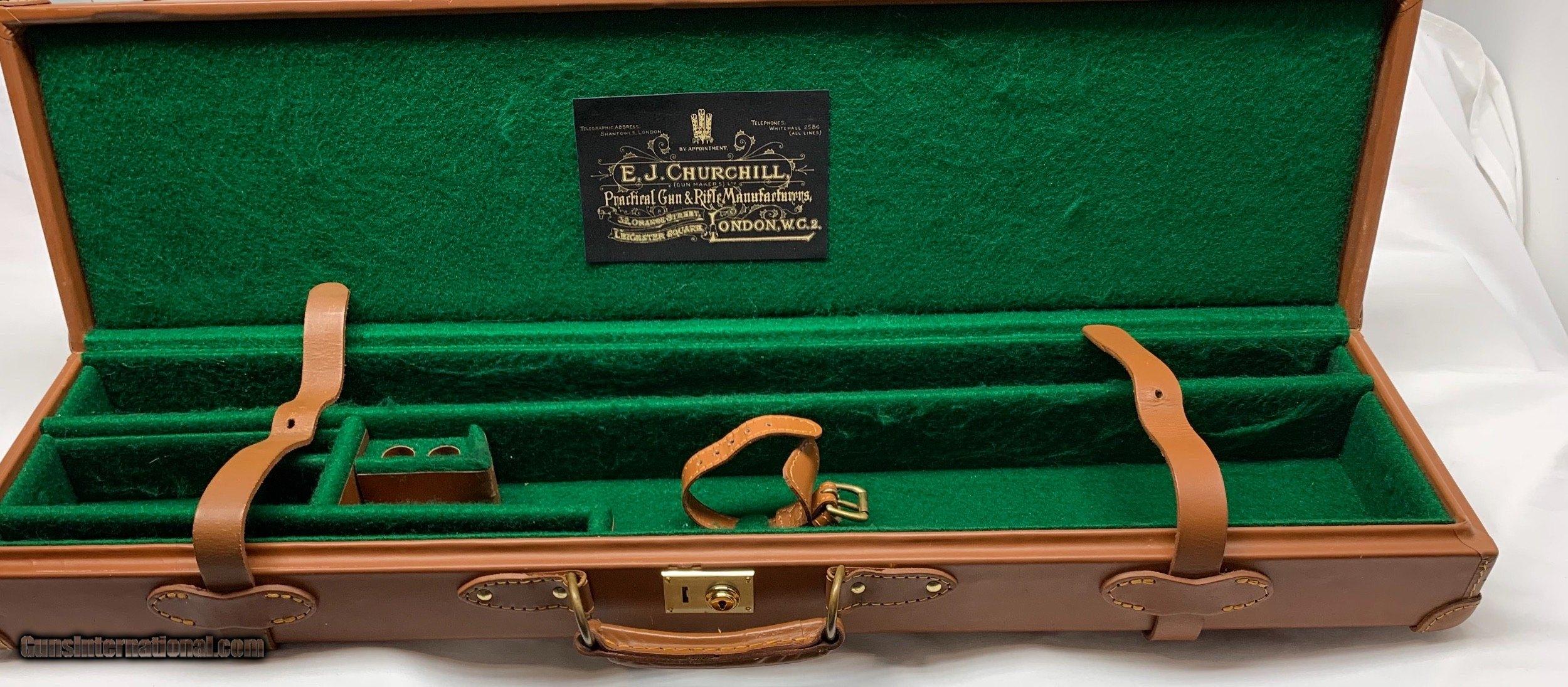
A fitted case can preserve much more than a gun. Trade labels, case linings, accessories and addresses help connect a surviving Churchill to the period in which it was made and used.
These details are especially valuable with historic London guns, where maker identity and provenance can survive in the case long after other documentation has disappeared.
Fitted cases preserve the visual language of the house.
Surviving Churchill cases show how the maker’s identity extended beyond the action and barrels — into labels, interiors, presentation and the practical equipment surrounding a sporting gun.
A London idea that outlived its era.
More than a century after Edwin John Churchill opened his workshop, the company name remains part of British sporting culture. The modern E.J. Churchill business continues from the West Wycombe Estate in Buckinghamshire, with gunmaking forming part of a wider sporting operation.
Historically, however, Churchill’s most distinctive contribution may remain the idea that handling itself could define a gunmaker’s identity. The XXV made that philosophy visible in a form collectors still recognize immediately.
English Doubles currently documents E.J. Churchill sporting guns, including a pair of Premier sidelock ejectors and another lightweight game gun associated with the Churchill name.
View E.J. Churchill in the Collection →Continue exploring British gunmaking.
Discover the histories, craftsmanship and traditions of other celebrated British gunmaking houses.