Reading British
Proof Marks
An introduction to the marks found on historic British sporting guns and what they can reveal about a gun’s story.
A history written
in steel.
Turn over the barrels of an old British sporting gun and you may find a collection of tiny crowns, letters, numbers and symbols stamped into the metal.
To the untrained eye they can appear almost decorative. In reality, proof marks belong to a regulated system of testing that has accompanied British gunmaking for centuries.
Read together and in the correct historical context, these marks can help identify where a gun was proved, the type of proof it underwent and other details that may contribute to understanding its history.
What does
“proof” mean?
Proof is the formal testing of a firearm to establish the soundness of its barrel and action under prescribed proof conditions.
Once a gun successfully passes the required proof, identifying marks are applied by the Proof House.
These stamps therefore belong to the gun’s regulatory history rather than being maker’s decoration.
Proof marks are often
hidden in plain sight.
On a traditional break-action shotgun, many of the most interesting marks are found on the flats beneath the barrels and on the action itself — areas that may be concealed when the gun is assembled.
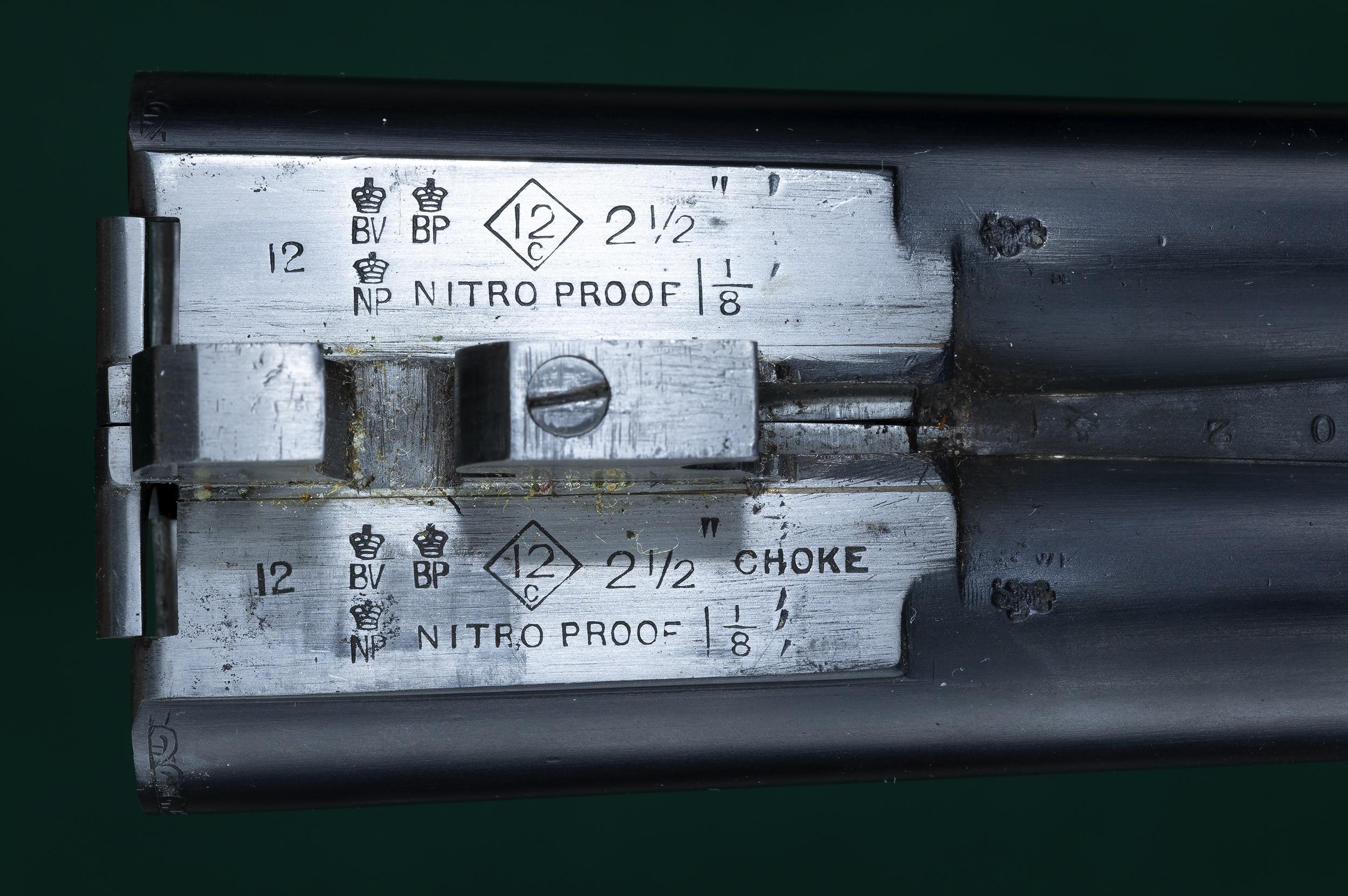
This is why photographs of only the exterior engraving or maker’s name rarely tell the entire story of a historic gun. The less glamorous surfaces underneath can contain some of its most useful historical evidence.
Read the complete group
A single crown, number or letter should rarely be interpreted in isolation. British proof rules and marking systems changed over time, and similar-looking marks may have different meanings depending upon the period in which they were applied.
The most useful approach is to consider the entire group of marks together with the maker’s name, serial number, barrel inscriptions, case labels and the physical characteristics of the gun.
What can proof marks
tell us?
Depending upon their period and type, British proof marks can provide several different pieces of information.

Proof House
The style of the official marks can help establish whether a gun passed through London, Birmingham or another recognized Proof House.
Type of Proof
Marks may distinguish different categories of proof, including historic black-powder and nitro-proof systems.
Dimensions
Depending upon the rules in force at the time, barrel markings can record information relating to bore or chamber dimensions.
Period
Changes in proof rules and mark styles can sometimes help narrow the period in which a particular proof took place.
Reproof
Additional proof marks may indicate that a gun returned to a Proof House after later work, alteration or another reason requiring reproof.
Another Chapter
Multiple generations of marks can sometimes reveal that a gun continued to be used, modified or examined long after it originally left its maker.
Proof marks do not simply identify a test. On an old gun, they can become part of its biography.
Each surviving mark records another moment in the gun’s history.
London & Birmingham
Britain’s two surviving Proof Houses are inseparable from the history of the country’s sporting-gun trade.
London
Proof House
The Worshipful Company of Gunmakers was incorporated by Royal Charter in 1637. The London Proof House remains part of that nearly four-century tradition of proof and inspection.
Birmingham
Proof House
Birmingham’s Proof House was established in 1813, reflecting the enormous scale and importance of the city’s gunmaking industry.
Not every stamp
means the same thing.
Proof rules developed over generations. The symbols used on a Victorian sporting gun may differ considerably from those found on a gun proved many decades later.
Definitive Proof
Official marks indicate that the completed arm passed the applicable definitive proof required under the rules in force at that time.
Black-Powder Proof
Historic markings can identify arms proved under black-powder standards, an important distinction when examining an older sporting gun.
Nitro Proof
Later proof systems distinguish arms that successfully underwent proof for nitro, or smokeless, propellants.
Superior Proof
Modern British and C.I.P. marking systems distinguish standard from superior proof where the applicable proof category requires it.
Reproof
A gun submitted again after qualifying alteration or for another required reason receives marks associated with reproof.
Special Marks
Other markings can relate to particular proof categories, repairs, conversion work, steel-shot proof or dimensions, depending upon the era.
Black powder
and nitro proof.
One of the most important historical distinctions found among older British proof marks is the difference between proof for black powder and proof for later nitro propellants.
As ammunition technology changed, proof standards and markings changed with it.
For the historian or collector, those different generations of marks can help place a gun within the technological world in which it was used.
Proof marks evolved
with the gun trade.
Proof Becomes Institutional
London’s proof tradition grew from the seventeenth-century Gunmakers Company and its responsibilities for the regulation of the trade.
Birmingham Joins the System
Birmingham’s Proof House was established in 1813 as the city’s gunmaking industry became one of Britain’s great manufacturing trades.
Black Powder to Nitro
New propellants and evolving ammunition required proof standards and marks capable of distinguishing different forms of proof.
C.I.P. Standards
Modern British proof operates alongside the international C.I.P. system, with standardized categories and marks used for current proof.
When a gun returns
to proof.
Proof is not always a once-in-a-lifetime event for a sporting gun. Certain alterations or repairs can require the arm to be submitted for proof again.
Reproof marks therefore have particular historical interest. They can show that a gun passed through a Proof House at another point in its life — sometimes many years after its original manufacture.
Read the marks
as a group.
The greatest mistake when learning proof marks is to find one familiar-looking symbol and immediately assign a date or meaning to the entire gun.
Proof rules have changed repeatedly, and an individual sporting gun may carry marks from more than one period. Rebarrelling, reproof or other work can add later marks alongside earlier ones.
Instead, consider every visible stamp together. Compare the proof-house symbols, proof type, dimensional information, maker’s marks and any signs that the gun returned for later proof.
Then compare those findings with the maker’s records, serial-number information and the gun’s other physical characteristics.
Proof marks become most valuable when they are treated as one part of the complete historical record.

Read the gun’s
other surviving clues.
Proof marks become more useful when they are considered alongside maker identity, trade labels, serial numbers, fitted cases and the physical details of the gun. These surviving materials can help build the broader historical context around a set of marks.


Historic proof marks are evidence — not a current safety inspection.
Genuine proof marks show that a firearm passed the applicable proof at a particular point in its history. They should not automatically be interpreted as confirmation of its present condition.
Later alteration, wear or changes to dimensions can affect proof status. British Proof Authority guidance also cautions against treating an arm proved only for black powder as though it had been proved for modern nitro ammunition.
When the present proof status, condition or appropriate ammunition for a historic sporting gun is uncertain, consult an appropriate Proof House or qualified professional rather than relying on marks alone.
One clue among
many.
Proof marks are most revealing when considered alongside everything else that has survived with a gun.
A maker’s case label may preserve an old address. Serial numbers can connect a gun to factory records. Barrel inscriptions, dimensions and engraving may reveal another part of its history.
Add the proof marks and a fuller picture begins to emerge: not simply who made the gun, but something of the life it has lived since.
Three rules for
reading proof marks.
Look Underneath
Important marks on traditional break-action guns are commonly found on the barrel flats and action rather than on the most visible exterior surfaces.
Read the Group
Never assume that one symbol tells the entire story. Context, period and the complete combination of marks matter.
Separate History From Condition
Old proof marks are valuable historical evidence, but they do not replace a current professional assessment of a historic gun.
Official Sources & Further Reading
Every mark adds
another piece of the story.
Continue exploring the makers, craftsmanship, history and details that give historic British sporting guns their remarkable character.
English Double Shotguns
Place British proof marks within the complete story of English double shotguns, including actions, makers, craftsmanship and identification.
Read the Complete Guide →